Omaha Poker: The Differences Hold’em Players Must Learn
Four private cards do not give you permission to use all four. Understand Omaha’s defining rule, work through common errors and compare rooms on the details of the actual game.

Reader transparency: we may earn a commission from clearly identified affiliate links. This guide explains selection criteria; it does not promise winnings. How we are funded.
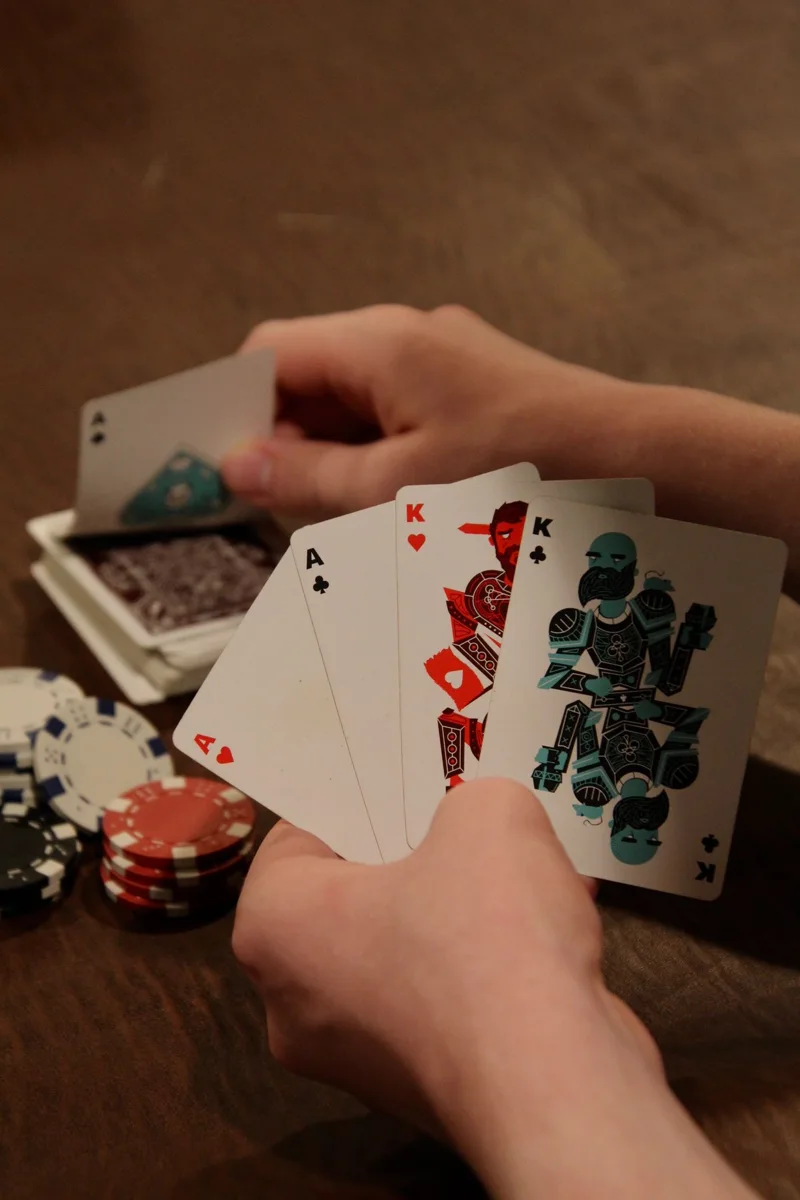
In standard four-card Omaha, make the hand with exactly two private cards and exactly three community cards.
The extra cards change more than the appearance
A Hold’em player opening an Omaha table may recognize the dealer button, blinds and community cards and assume the transition is simple. The most important change is also easy to overlook: standard four-card Omaha gives each player four private cards, but the final five-card hand must use exactly two of them and exactly three cards from the board. Familiar-looking hands can therefore have unfamiliar results.
Start by reading the room’s exact game label. Omaha high, Omaha hi-lo and versions with additional private cards are distinct products. A casino’s house-banked game with Omaha in its name may have another rule set again. This guide concerns ordinary four-card Omaha high unless otherwise stated. The PokerStars Omaha rules provide an official introduction to that format.
Work through the single-suit mistake
Imagine your private cards contain the ace of hearts, king of clubs, queen of diamonds and jack of spades. The board contains four hearts and one club. In Hold’em, a player holding the ace of hearts could potentially use it with four hearts from the board. In standard Omaha, you cannot do that: you must use two private cards, and you hold only one heart. Those cards do not make a heart flush.
Reverse the exercise. If you hold two hearts and the board contains three hearts, you can combine those five suited cards, subject to whether another available combination makes a stronger hand. Physically separating two private cards from three board cards during study helps break the Hold’em habit. Do this without real-money stakes until the construction feels straightforward.
Check paired boards rather than borrowing a full house
A board with three kings and two eights already displays a full house, but an Omaha player cannot simply play all five board cards. Exactly three community cards must be used. Depending on the private cards, a player may make a full house, four of a kind or a weaker hand. The visible board does not automatically give everyone the same result.
Build candidate hands deliberately. If you hold ace, ace, queen and jack, combining the two aces with the three kings makes kings full of aces. If you hold unrelated cards that do not pair the selected board cards, you may have only three of a kind with kickers. This exercise is about valid construction first; guessing how often another player has a particular holding is a separate question.
Learn what pot limit permits
Many Omaha tables use pot-limit betting. The maximum allowed raise depends on the current pot and the amount needed to call, rather than simply allowing your entire stack on every action. Check the room’s explanation and use its displayed legal controls; guessing from the size of a previous bet is unreliable. The table label should explicitly identify the betting structure.
For a simplified example with no side pots, suppose the pot contains 10 units before an opponent bets 5. There are now 15 units in the middle. After you call the 5, the pot is 20, so a pot-sized raise adds 20 beyond your call, making your total contribution for that action 25. This arithmetic describes a maximum in that situation, not advice to place it.
Do not equate more possibilities with better prospects
Four private cards create several two-card combinations, and a colorful starting hand can look attractive for multiple reasons. That visual appeal does not establish that it is profitable to continue. Draws may overlap, a possible flush may be below another possible flush, and a made hand can still be overtaken. The amount available to lose remains real even when the cards feel unusually promising.
For a practical study session, choose a handful of boards and list valid made hands rather than predicting winnings. Identify the strongest possible hand on each board and then check whether your own cards can form it using the exact rule. If learning a new variant makes you uncertain, keep the activity outside real-money play instead of paying for confusion at a larger table.
Compare Omaha availability at the right level
| Room detail | What to verify |
|---|---|
| Variant | Four-card high, hi-lo or another explicitly named version |
| Betting structure | Pot limit, fixed limit or no limit |
| Table availability | Active games at an affordable stake and useful time |
| Costs | Omaha-specific rake, caps and special deductions |
| Learning support | Accurate rules, readable cards and accessible practice options |
Do not assume a room’s Hold’em pricing applies to Omaha. Official schedules can separate variants and stakes. Compare the actual row for the game you intend to use. If the only active Omaha table exceeds your budget, the room does not fit this purpose at that time, regardless of its overall popularity or casino library.
Read commercial recommendations with the variant in mind
An affiliate page may use poker as one broad category while discussing almost entirely Hold’em. A useful Omaha recommendation should say which version is available, show where the relevant rules and pricing can be verified, and avoid presenting speculative traffic claims as observations. A welcome bonus should never be the reason to enter a game whose hand construction you cannot yet apply reliably.
Keep the distinction between education and operator endorsement clear. A source explaining rules is not evidence that the publisher has tested withdrawals or partnered with that room. For further checking, the California Department of Justice’s published cardroom rules also illustrate the two-private-card distinction. Those local rules are useful corroboration of the game mechanics, not proof of online availability in your location.
Frequently asked questions
Can I use one private card to make an Omaha flush?
Not in standard Omaha. You need exactly two private cards and three board cards, so a flush requires two suited private cards and three matching suited community cards.
Is every Omaha game pot limit?
No. The variant and betting structure must be checked separately. Read the table or event rules rather than assuming the most familiar format applies.
Sources & further reading
Primary and authoritative references used for this guide. Checked 7 September 2026. Rules and availability can change; consult the relevant live source.
- PokerStars: Omaha rules ↗
- California DOJ: Club One cardroom rules ↗
- PokerStars: variant-specific rake schedule ↗
Photography: cover source and article source, via Pexels.